
“History is not simply found in old buildings. It is found in the lives of the people who built them.”
More Than a Building. A Legacy Worth Preserving.
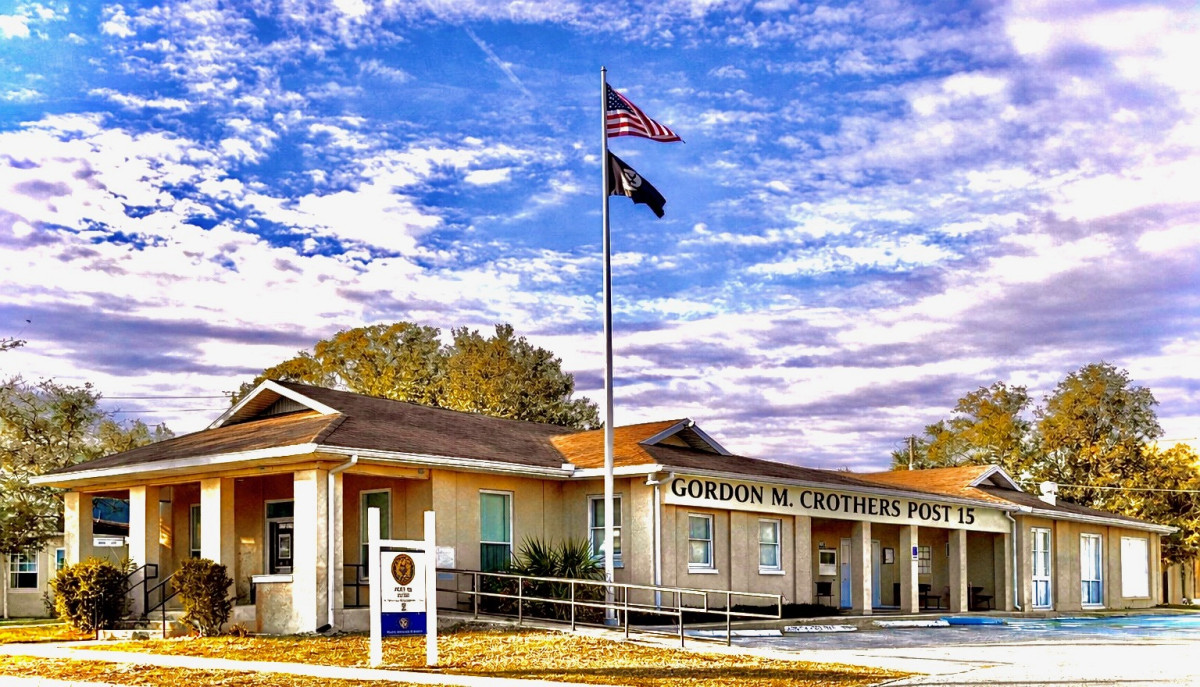
Most people drive down Church Avenue and see an old building.
We see something more.
We see the home built by a generation of veterans who returned from the First World War determined to continue serving their community.
We see a place created by men who understood sacrifice, service, and responsibility to one another. A place that has stood for nearly a century as the home of Gordon M. Crothers American Legion Post 15.
And today, through the Gordon M. Crothers Legacy Project, we are learning more about those veterans, the Post they created, and the remarkable story behind the building they left to us.
That research has given new meaning to our effort to preserve their historic home.
The Gordon M. Crothers Memorial Preservation Project is not simply about repairing an old building.
It is about protecting a tangible connection to the veterans who came before us—and ensuring that what they built continues to serve veterans and the Dade City community for generations to come.
It is more than a building. It is a promise.
Who Was Gordon M. Crothers?

Before there was an American Legion Post 15, there was Gordon M. Crothers.
Gordon was a young man from the Dade City community who served during the First World War as a Corporal in Company M, 126th Infantry, 32nd Division.
In the summer of 1918, his regiment was fighting in France during the Aisne-Marne campaign. Gordon was killed in action on August 1, 1918.
He never returned home.
Less than a year later, Dade City's returning veterans gathered to organize a local post of the newly forming American Legion. When the time came to choose a name, they chose his.
The Dade City Banner reported in June 1919 that “Gordon Crothers Post” had been selected in honor of Corporal Gordon M. Crothers, who had been killed in action in France.
More than a century later, his name still stands above the entrance to the home those veterans eventually built.
Gordon M. Crothers never had the opportunity to help build Post 15. His fellow veterans made certain that his name would always be part of it.
A New Post — and a Name to Remember
On May 30, 1919, Dade City's returning veterans gathered to organize a local post of the newly forming American Legion.
They chose the name “Gordon Crothers Post” in honor of the young Dade City soldier who had been killed in France less than a year earlier.
The first officers chosen to lead the new organization were:
Commander — W. W. Huckabay
Vice-Commander — Walter Craig
Adjutant — R. B. Sturkie
Finance Officer — Stanley Cochrane
Sergeant at Arms — James Ward
The Dade City Banner announced the organization of the new Post on June 6, 1919. The following day, June 7, twenty-eight local veterans signed the Post's charter application, formally beginning the process of becoming part of The American Legion.
That charter was accepted by The American Legion on December 9, 1919.
These were veterans who had only recently returned from wartime service. They could have simply resumed their individual lives.
Instead, they created something together.
They established an organization through which veterans could continue serving one another and their community—and they placed at its center the name of a fellow serviceman who had not returned with them.
That was the beginning of our legacy: Gordon M. Crothers American Legion Post 15.
The Dream of a Home — 1921
In October 1921, Post 15 organized an effort to establish a permanent clubhouse. Contemporary newspaper reports described committees for the site, plans and financing, about $1,000 raised or pledged, and approval of a $500 purchase from A. J. Burnside.
The surviving deed documents a conveyance from Burnside and his wife to trustees acting for the Post on October 15, 1921. It was recorded on February 6, 1923, in Pasco County Deed Book 54, page 183. These are separate milestones: execution in 1921 and recording in 1923. The deed describes part of the property associated with the later Post home; it does not establish that the entire present parcel was acquired at once.
The first building campaign stalled. Although construction bids were solicited in November 1921, the retained research has not established that the proposed clubhouse was built. The exact reasons for the delay and the campaign's full financial history remain unresolved.
When construction moved forward in 1927, the Dade City Banner described the location as the Post's previously purchased lot on West Church Street, just east of the waterworks. That contemporary report, read with the deed, supports continuity between the early acquisition and the site of the new Legion Home.
What We're Discovering
History isn't static when the research is still underway.
As we examine historic newspapers, photographs, property records, military records, and other surviving evidence, we continue to uncover details that add to—and sometimes change—our understanding of Post 15's history.
We'll continue updating this page as new evidence is discovered.
The building research now documents a property conveyance to Post trustees on October 15, 1921, recorded February 6, 1923; renewed construction activity in 1927; the cornerstone ceremony on November 11, 1927; and dedication of the Legion Home on January 9, 1928. Some finishing work remained after dedication. Each date marks a different step in the creation of the Post's permanent home.
Some discoveries answer old questions. Others give us entirely new ones to investigate.
The Cornerstone — 1927
Six years after Post 15's first documented attempt to build a permanent clubhouse, a Legion Home was finally becoming a reality.
By the fall of 1927, construction of the new American Legion home on Church Street was underway.
On Armistice Day, November 11, 1927, Dade City came together to mark the occasion.
A parade formed at the courthouse square and traveled through the city before turning onto Church Street and proceeding to the new American Legion building, which the Dade City Banner described as “now in process of erection.”
More than 500 people gathered at the construction site for the ceremony.
R. B. Sturkie, Post 15's first Adjutant and one of its founders, served as master of ceremonies. Community and Legion leaders spoke about patriotism, service, veterans, and the importance of supporting the new Post home.
Then came a moment that still connects us directly to that day.
Past Department Commander Harvey R. Payne stepped onto a scaffold and, assisted by James Ward—one of Post 15's founders and superintendent of construction of the new building—laid the cornerstone.
Behind the stone they placed a roster of the Post and Auxiliary, membership emblems from both organizations, and a copy of the Dade City Banner's American Legion edition of November 8, 1927.
That newspaper had been published just three days before the ceremony. It told the story of Post 15, described its service to the community, celebrated the construction of the new Legion Home, and announced the upcoming cornerstone ceremony.
In an editorial supporting the project, the Banner explained what the veterans intended their new home to be:
“They are erecting this building not only for themselves, but for public use.”
That purpose has endured.
The marble cornerstone bearing the dates 1919 and 1927, along with the names of Gordon M. Crothers Post 15 and its Auxiliary Unit, remains part of our building today.

Nearly a century later, we can stand before that same cornerstone knowing that behind it remains a record of what those veterans were building—and why.
They built a home for veterans, but they also built a place to serve their community. Nearly a century later, that remains our purpose.
A Home at Last — 1928
By the end of December 1927, the home Post 15's members had envisioned for more than six years was nearly complete.
The Dade City Banner reported that the plastering had been finished and the floors were being laid. Windows and doors still had to be installed, and the exterior stucco remained to be completed.
The newspaper described what the veterans had built: a one-story structure of concrete tile covered with stucco, with a main section measuring 30 by 66 feet and two adjoining wings.

One of those wings contained “a large fireplace and mantel.” The other was designed for use by the Women's Auxiliary and as a kitchen, with a removable partition allowing the space to serve different purposes. A broad porch extended across the front of the building.
That fireplace and mantel—documented before the building even opened—remain part of the Post 15 home today.

The description carried an even greater significance. The newspaper explained the purpose of the building itself:
“Erected as a post home and memorial to the World War veterans of Pasco county...”
On January 9, 1928, the new Legion Hall was formally dedicated.
The evening began with a chicken dinner attended by 51 people, including Post and Auxiliary members, community leaders, Department Commander A. Rice King, Department Adjutant Howard Rowton, and three past Department Commanders. The gathering then moved to the new hall, where officers of both Post 15 and its Auxiliary were installed and the building was formally dedicated. A dance followed the ceremonies.
And almost immediately, the new home began fulfilling the community purpose envisioned for it.
Just two days after the dedication, the local Woman's Relief Corps discussed Post 15's offer of free use of the new Legion Hall, an offer the newspaper reported was received with “many expressions of appreciation.”
Only weeks earlier, the Banner had written that Post 15's veterans were erecting the building “not only for themselves, but for public use.”
Now their home was complete, their memorial stood on Church Street, and that promise of service was already being put into practice.
Nearly a century later, the fireplace still stands, the memorial still bears their name, and the building continues to serve the veterans and community for whom it was built.
A Legacy of Service
The new Legion Home gave Gordon M. Crothers Post 15 a permanent place to gather.
But the work of the Post was never intended to stop at its doors.
Even before the building was completed, Post 15's members were active throughout Pasco County. They organized Memorial Day observances and sent delegations to rural cemeteries where veterans of America's wars were buried, placing flags and flowers on their graves. The Post was also working to compile a complete record of former soldiers and sailors buried in Pasco County cemeteries.
Their service extended to the broader community. Post 15 supported civic projects and was credited with helping secure playground equipment for Dade City's grammar school.
In an Armistice Day editorial published in November 1927, the Dade City Banner reflected on what continued service meant for the veterans who had returned home:
“The real legionaires is not an ‘ex-service’ man, but is still serving, as a citizen, even as he served in the armed forces during the war.”
The following year, Post 15's members would demonstrate that principle on a much larger scale.
In September 1928, a devastating hurricane struck South Florida, bringing catastrophic destruction and loss of life to communities around Lake Okeechobee.
Gordon M. Crothers Post 15 responded.
The Post contributed $100 toward hurricane relief, and members volunteered to travel to the affected area to assist with the relief effort.
For the veterans who created Post 15, service had not ended when they came home from war.
They simply found new ways to serve.
The building gave them a home. Their service gave that home its purpose.
The Legacy Is Now Ours
Nearly a century has passed since the veterans of Gordon M. Crothers Post 15 built their home on Church Street.
The world around it has changed.
Generations of veterans have passed through its doors. Meetings have been held, meals shared, ceremonies conducted, friendships formed, and countless hours devoted to serving veterans and the community.
And through it all, the building has remained.
Today, we understand more about that building—and the people who created it—than we did only a few years ago.
Through the Gordon M. Crothers Legacy Project, we are recovering that history from newspapers, military records, photographs, documents, and other surviving evidence. Each discovery helps us better understand the veterans who founded Post 15, the community that supported them, and the purpose behind the home they built.
That research has also changed the way we look at preservation.
We now know that the building was described before its completion as both a Post home and a memorial to the World War veterans of Pasco County.
We know its builders intended it “not only for themselves, but for public use.”
We know that its original fireplace and mantel still stand inside.
We know that the cornerstone laid on Armistice Day in 1927 remains part of the building—and that behind it rests a small collection deliberately placed there by the veterans and Auxiliary members who built this home.
These are no longer simply interesting details about an old building.
They are reasons to preserve it.
The Gordon M. Crothers Memorial Preservation Project exists to protect this historic home, address the needs of an aging building, and help ensure that it can continue serving veterans and the Dade City community well into its second century.
The veterans who came before us built something they believed was worth leaving behind.
The legacy they created is now our responsibility.
Help Preserve the Legacy
Preserving a building that has served veterans and the Dade City community for nearly a century is an ongoing responsibility.
The Gordon M. Crothers Memorial Preservation Project was created to help protect the historic Post 15 home while ensuring that it remains a safe, useful, and welcoming place for future generations.
That work includes maintaining and repairing an aging building, protecting its historic features, and addressing major preservation needs as they arise.
We have already made progress, thanks to the generosity of Post members, local businesses, community partners, and friends who believe this piece of Dade City history is worth preserving.
But there is more work ahead.
There are many ways to be part of that effort.
You can support the Preservation Project financially. You can attend or support Post 15 activities and fundraisers. You can share our history with others. And you can help us continue discovering and preserving the photographs, documents, stories, and memories that make up the Gordon M. Crothers Legacy Project.
Every contribution—whether it is a donation, a historical photograph, a shared story, a few hours of volunteer service, or simply telling someone else about this remarkable place—helps carry the legacy forward.
The veterans who built this home did their part.
Now it is our turn to preserve what they left behind.
Their Legacy. Our Responsibility.
Learn the history. • Share the story. • Help preserve the legacy.