
The Post 15 Legion Home
From the first property acquisition to a permanent home, 1921–1928
Gordon M. Crothers Legacy Project | Historical Information Package GMC-HIP-006
Web adaptation of approved HIP Version 1.0, with the material-support clarification documented in GMC-HAUP-006 Version 1.2. Prepared October 19, 2026.

The Legion Home before later expansion. Date undetermined. The photograph bears the inscription “Kenfield / Dade City Fla.” Project photograph collection. [14]
The home of Gordon M. Crothers American Legion Post 15 grew from a property acquisition in 1921, an unrealized clubhouse proposal, and a renewed building campaign in 1927.
Its cornerstone was laid on November 11, 1927. The Home was dedicated on January 9, 1928, although a few finishing touches remained. Contemporary reporting described the building as both a Post home and a memorial to Pasco County’s World War veterans. [1–13]
The First Effort: 1921
In October 1921, the Dade City Banner reported that the Post had approximately 45 members, committees working on a site, plans and financing, and about $1,000 raised or pledged toward a clubhouse. On October 14, the newspaper announced the purchase of two Church Street lots from A. J. Burnside for $500, with trustees to hold title. [1]
The surviving warranty deed documents the conveyance on October 15, 1921. Burnside and his wife conveyed the described property to Post trustees Adrian H. Hall, C. B. Taylor and R. J. Henderson for $500. The deed was recorded on February 6, 1923, in Pasco County Deed Book 54, page 183. Execution and recording were separate events. [2]
The description covers the north end of Lots F and G in Block 2 of Grady’s Addition and a portion of former street between the F and G lots of Blocks 2 and 1. It does not establish that every part of today’s parcel was acquired in 1921. [2]
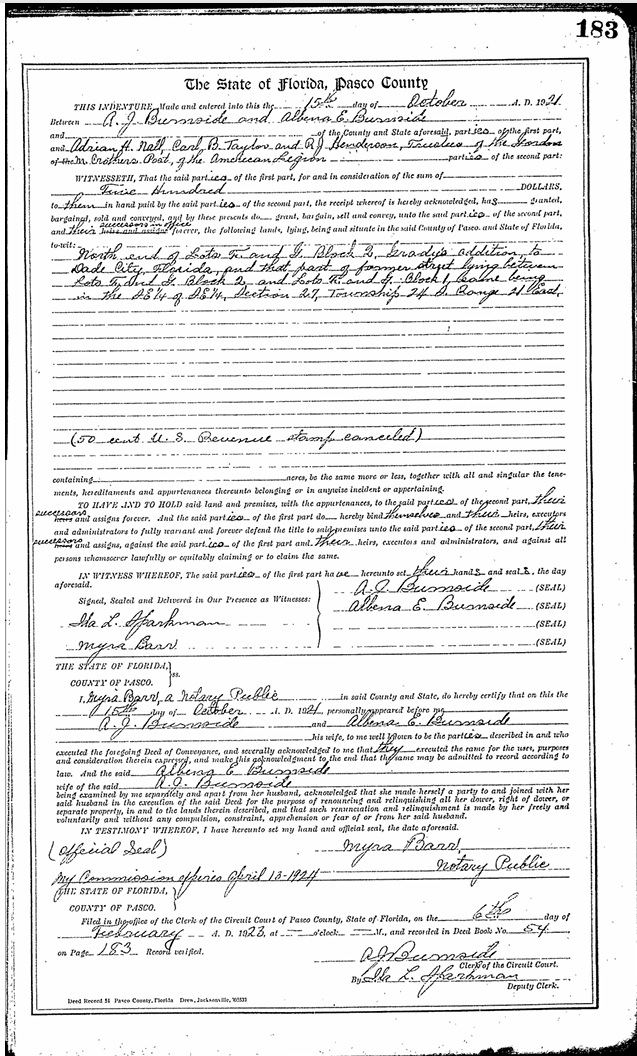
Warranty deed to Post trustees, executed October 15, 1921, and recorded February 6, 1923. Pasco County Deed Book 54, page 183. [2]
The proposed clubhouse was a one-story frame building approximately 30 by 60 feet. Plans included a front club and assembly room, six rear rooms, shower and toilet facilities, and running water. The rear rooms were contemplated for bachelor members. This proposal was different from the Home ultimately constructed in 1927. [15]
A November 4, 1921 notice requested construction bids due November 14. It offered alternatives for labor and materials together, or labor alone with the Legion supplying materials. The notice documents a serious building effort, but does not establish that a contract was awarded or a clubhouse completed. [3]
A Campaign That Stalled
The first effort did not produce the later Legion Home. By December 15, 1922, the Banner again reported discussion of the lot, payment and a possible temporary building. Members committed half of incoming funds to a building fund. [4]
The evidence does not establish one exact reason for the delay. Questions about financing and the delayed recording of the deed remain unresolved. [2, 4]
When the successful campaign began in 1927, the Banner located the proposed Home on the lot purchased by the Post several years earlier, on West Church Street just east of the waterworks. Read with the deed, that report supports continuity between the early acquisition and the later building site. [2, 6]
A Renewed Campaign in 1927
On September 19, 1927, members met at the home of Mr. and Mrs. Edgar Rawls and decided to proceed using available resources. The September 23 Banner reported about $650 in subscriptions of cash and labor and a favorable offer of wall material. Plans were still developing, and Post and Auxiliary members were invited to submit sketches to James Ward. [5]
Dade City Concrete Products Company offered building material at a favorable figure. Its documented role was material support; this evidence does not identify the company as the builder of the Legion Home. [5; HAUP Version 1.2 clarification]
The early concept was approximately 40 by 60 feet. Those preliminary dimensions should not be confused with the component dimensions reported as the Home neared completion. [5, 11]
Building Through Community Support
By October 4, 1927, building material was on the ground and work was expected to begin that week. The proposed Home would accommodate meetings, entertainments, lectures and dancing, with a stage and rooms for Auxiliary, committee and kitchen uses. The newspaper estimated the completed building at about $6,000. That was a contemporary estimate, not a verified final cost. [6]
James K. Ward Jr. played a leading role in planning and supervising construction. The Banner described him as an experienced builder and Post member contributing most of his services, equipment and a substantial subscription. Cash contributions were directed to Post Adjutant W. C. Craig, while labor offers were directed to Ward. [6]
The City supplied free water and sewer connections and tax exemption. An October 11 newspaper correction explained that a proposed $200 donation originated with Councilman I. W. Smith, rather than a Legion request. No City cash donation was made. [7]
At its October 11 meeting, the Post voted to incorporate to take title and control the clubhouse and ratified earlier construction actions. That vote was an organizational step; it was not itself a deed transferring the trustees’ property into a corporation. [8]
Together, these records describe a project supported by Post resources, cash and labor subscriptions, supplied materials, Ward’s services and equipment, citizens’ assistance and municipal support. A complete financing ledger has not been established. [5–9]
The Cornerstone: November 11, 1927
On Armistice Day, a parade brought participants to the Legion building, which was still under construction. The Banner reported an audience of more than 500 people, with R. B. Sturkie serving as master of ceremonies. [10]
Past Department Commander Harvey R. Payne laid the marble cornerstone with assistance from James Ward, identified as superintendent of construction. The newspaper recorded the deposit of a Post and Auxiliary roster, a membership emblem of each organization, and the Banner’s special American Legion edition of November 8, 1927. The present condition of those deposited materials has not been verified. [10]

The cornerstone commemorates the Post and Auxiliary and bears the dates 1919 and 1927. The laying ceremony took place November 11, 1927, while construction was underway. [10]
Three days before the ceremony, the Banner explained the intended public purpose:
“They are erecting this building not only for themselves, but for public use.” [9]
The Auxiliary’s participation appears in the planned interior uses, cornerstone deposit, inscription and later joint installation ceremonies. These records establish an important institutional role without establishing a particular share of construction financing or labor. [10–13]
A Home and a Memorial
On December 30, 1927, the Banner described the nearly completed Home as a one-story building of concrete tile covered with stucco. Plastering had been finished, flooring was being laid, and windows, doors and exterior stucco work remained unfinished. [11]
The newspaper reported these dimensions:
-
Main portion: 30 by 66 feet
-
Smaller wing, containing a fireplace and mantel: 8 by 20 feet
-
Larger wing, for Auxiliary use and a kitchen: 12 by 20 feet
-
Front porch: 30 by 10 feet
These are contemporary reported dimensions, rather than a modern measured survey. [11]

The December 30, 1927 Banner described a fireplace and mantel in the smaller wing. A present-day photograph illustrates the feature; the report alone does not establish the age of every surviving component. [11]
The same article described the building as a Post home and memorial to the World War veterans of Pasco County. Its memorial purpose was therefore expressed during construction. The source did not describe it as a memorial solely to Gordon M. Crothers. [11]
Dedication: January 9, 1928
The Pasco County News explicitly dated the dedication to Monday evening, January 9, 1928. The evening began with a chicken dinner at Marsh’s restaurant, followed by installation of Post and Auxiliary officers and dedication of the new Home on West Church Street. The newspaper counted 51 people at the dinner; that figure is not a total attendance count for all dedication activities. [12]
Visiting Legion leaders included Department Commander A. Rice King, Department Adjutant C. Howard Rowton, and past department commanders William Steitz, Harvey R. Payne and James W. Morris Jr. [13]
Mayor William Friedman spoke at the banquet and presented four $10 gold pieces for furniture as a gift from himself and his sons. This personal gift was separate from the City assistance reported during construction. [13]
The Home had reached its dedication, but the January 13 Banner still reported that a few finishing touches remained. Construction, cornerstone laying, dedication and final completion should therefore remain distinct milestones. [11–13]
The Historic Home Today
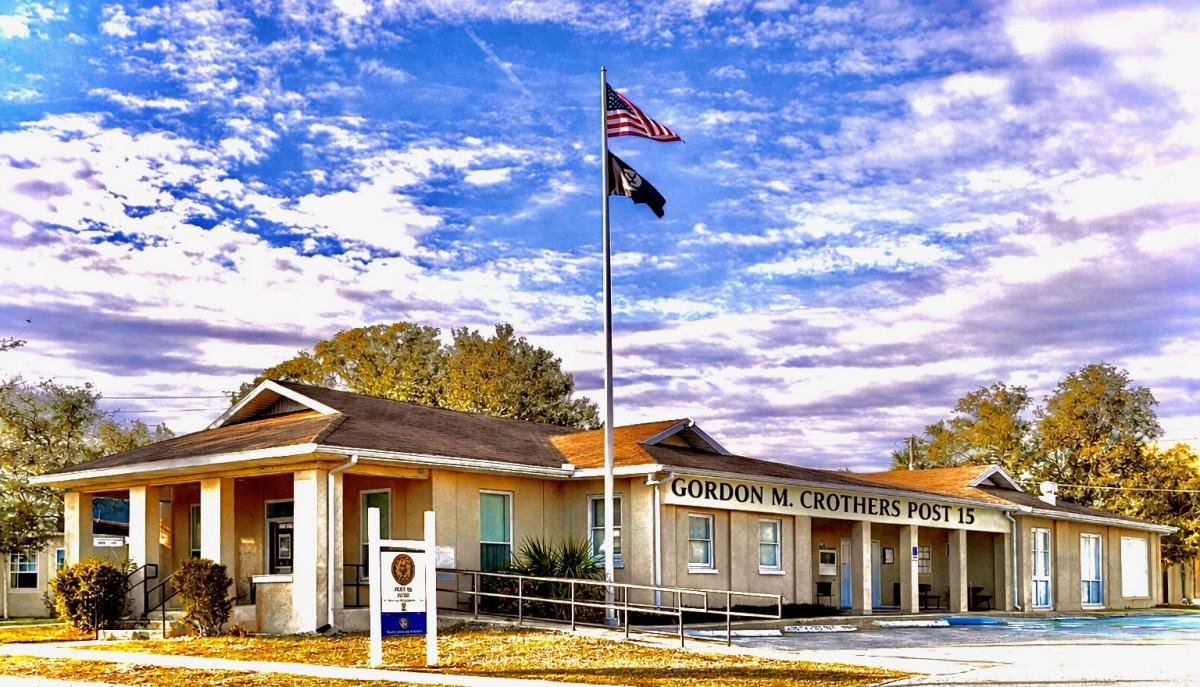
View supplied in September 2026 and described by the project owner as taken about a week earlier. Exact capture date and photographer are unrecorded. [14]
The historic and modern photographs show a recognizable front core within today’s enlarged building: a broad porch, substantial supports, central entrance, flanking windows and a hipped roof with a raised central gable. [14]
The comparison supports continuity of form. It does not establish the age of every component or the construction dates of later additions. Those questions require separate architectural and documentary research.
What Remains Unresolved
Research continues into the reasons the first clubhouse campaign stalled, its full financial history, the later transfer of title into the Holding Corporation, and the chronology of additions and alterations.
The deed and newspaper accounts support continuity of the historic site, but this package does not certify every present boundary or subsequent property transfer.
Sources and Research Notes
The numbers in brackets refer to the sources below. Newspaper dates identify publication dates; event dates are stated separately. Page references follow the retained research copies.
-
Dade City Banner, October 7 and October 14, 1921. Clubhouse campaign and “American Legion Buys Lots for Club House.”
-
Burnside deed to Post trustees, executed October 15, 1921; recorded February 6, 1923. Pasco County Deed Book 54, page 183. October 15 corrects an earlier December 15 transcription.
-
Dade City Banner, November 4, 1921, “Bids Wanted for Construction of Club House,” retained PDF page 11.
-
Dade City Banner, December 15, 1922, renewed lot and building discussion, retained PDF page 1.
-
Dade City Banner, September 23, 1927, “Legion Buys Building Material.” The material-company identification is documented in GMC-HAUP-006 Version 1.2.
-
Dade City Banner, October 4, 1927, “Building for Legion to Be Started,” retained PDF page 1 and continuation.
-
Dade City Banner, October 7, 1927, City assistance report, read with October 11, 1927, “Legion Did Not Ask City For Donation,” retained PDF page 1.
-
Dade City Banner, October 14, 1927, “Legion Post Decides to Incorporate,” front page and continuation on page 8.
-
Dade City Banner, November 8, 1927, special American Legion edition, public-use editorial passage, retained PDF page 2.
-
Dade City Banner, November 15, 1927, “Celebration of Armistice Day Is Held,” retained PDF pages 1 and 8. Its weekday reference is inconsistent; November 11 remains the supported ceremony date, corroborated by other reporting.
-
Dade City Banner, December 30, 1927, “Legion Home Now Nearing Completion,” retained PDF page 1.
-
Pasco County News, January 12, 1928, “Legion Hall Dedicated and Dinner Party Held,” retained PDF page 1.
-
Dade City Banner, January 13, 1928, “Legion Home Dedicated Monday,” retained PDF pages 1 and 7.
-
Project photograph collection, historic image
9297420480_3d3234b71b_o.jpgand modern imageImage (2).jpg. Historic date and full photographer attribution remain unrecorded; modern image supplied September 2026. -
Dade City Banner, October 21, 1921, “American Legion Adopt Plans for Club House.”
These citations identify the underlying records. They are not permanent Historical Knowledge Catalog record IDs.
Help Continue the Research
Photographs, letters, programs, building records and family memories may help fill gaps in this history. If you have material connected with the Legion Home, Post 15 or its Auxiliary, please contact us.
Return to the Legacy Project • Learn about the Preservation Project